Is Yellow-Green Foliage Normal on Mrs G.G. Gerbing Azalea?
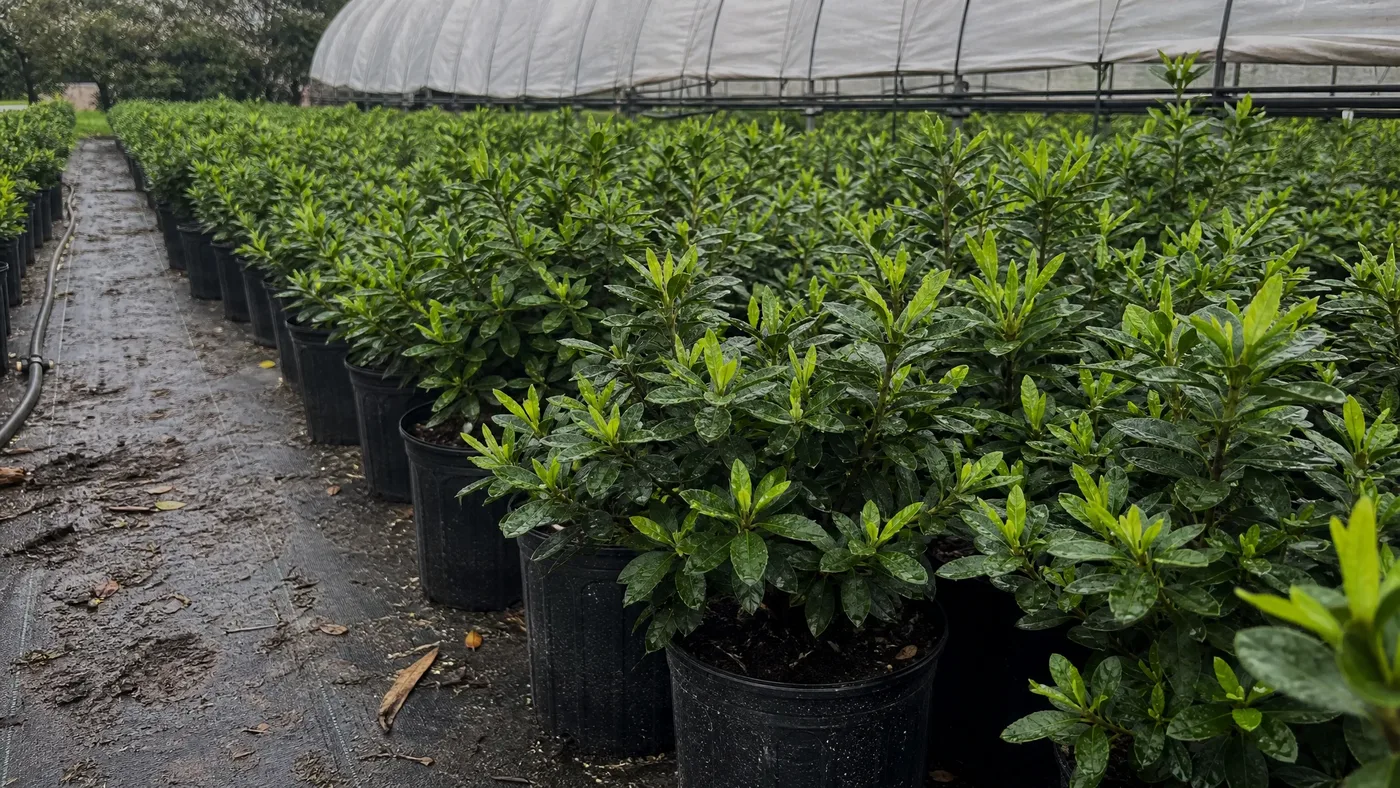
A healthy leaf of Mrs G.G. Gerbing reads a lighter, yellower green than a typical azalea on any color chart, year-round. That surprises people, especially after they have read about chlorosis and gone out to look at their own shrub.
Getting this wrong costs you either way. Treat a normal plant for a deficiency it does not have and you can injure the roots with fertilizer. Ignore real chlorosis and the new growth keeps fading. One of the most common questions we get is whether pale green means something is wrong. Read on for the baseline color, how season and leaf age shift it, the vein test, the soil pH numbers, the role of light, what iron and feeding can and cannot do, and a short checklist.
How Pale Is Normal on Mrs G.G. Gerbing Azalea?
Verdict: the light yellow-green is normal. It is a trait of this cultivar, not a symptom. Growers describe the foliage as yellow-green where most azaleas carry a deep, dark green, and that tone holds from the first flush of leaves through winter.
The useful word is even. A normal Gerbing has the same shade across the whole shrub, on the sunny side and the shaded side, on the top and the interior. Nothing about it looks mottled, patchy or washed out in one zone.
Why the Comparison Misleads You
Most photos in azalea care guides show darker-leaved plants, so the pale shade looks wrong beside them. Your neighbor's azalea may be a different cultivar with darker foliage, and that tells you nothing about yours. Compare a Gerbing with other Gerbings, or with its own leaves from last year.
The same goes for the Southern Indica hybrids as a group. A description of the whole group cannot tell you the tone of one cultivar. Trust the plant's own history: if it has always been this shade and still grows, it is fine.
Plants we ship carry this color from the start, so a pale green plant out of the box is not a defect.
Checking Color Under Fair Conditions
Judge color in the same light every time. Bright midday sun washes pale leaves out further, and deep shade makes them look darker than they are. Pick a morning or an overcast day, hold a mature leaf against a sheet of white paper, and photograph it with the paper in frame.
Repeat the photo at the same spot each season. A dated record turns a hunch into a comparison, and it settles most of the questions we would otherwise field by phone. If next spring's leaf matches this year's, nothing has changed.
Season and Leaf Age Change the Shade
Verdict: small shifts are expected, whole-plant shifts are not. Color moves a little with the season and with the age of the leaf, but it should never swing from yellow-green to yellow or white.
Shifts You Can Expect
New growth in spring looks fresher and a touch lighter than leaves a year old. As it hardens off, it settles toward the plant's usual yellow-green. A flush that is a shade lighter than the older foliage, with green veins and even color, is just a new leaf maturing.
Leaves also age and drop. A few older leaves turning yellow and falling over the year is ordinary turnover on a shrub that carries foliage year-round. Check with your local extension service for the leaf-drop timing in your zone.
Shifts That Signal Trouble
Watch the direction and the position of the change. The table sorts what you see by where it starts.
| What you see | Where it starts | Verdict |
|---|---|---|
| Slightly lighter new flush, green veins | Newest leaves | Normal |
| A few old leaves yellow and drop | Oldest, inner leaves | Normal in small numbers |
| Yellow tissue with green veins | Youngest leaves | Chlorosis |
| Yellowing and heavy loss of older leaves, thin canopy | Older leaves, whole plant | Suspect roots |
| Leaves turning white with burned edges | New growth | Severe iron deficiency |
The University of Florida notes that wet root rots cause yellowing and loss of older leaves, which looks like chlorosis but starts in a different place. True iron chlorosis shows in the youngest leaves.
Winter and Newly Planted Shrubs
Cold weather can dull any evergreen leaf for a while. Judge color in a mild spell, not during a freeze, and compare it with the same month last year. If the shade returns when the weather warms, the dullness was weather and not a deficiency.
A shrub planted within the last season is also a poor test subject. The roots are still settling, and a few older leaves may yellow and drop while they do. Wait for the next flush of new growth before you decide anything. That flush tells you more than the old leaves do.
Vein Pattern on Mrs G.G. Gerbing Azalea Leaves
The vein test is the fastest check you can make, and it takes one leaf. Hold a young leaf up to daylight and look at the veins against the tissue around them.
Verdict: even pale green is normal. Green veins on yellow tissue is not. On a healthy Gerbing the veins and the blade are nearly the same yellow-green, so the leaf looks uniform. In chlorosis the blade fades and the veins stay darker, which draws a visible net across the leaf.
Clemson describes the area between the veins as yellow or light green, while the veins are darker green. That contrast is the sign. A Gerbing that is merely pale shows no contrast at all.
Sample More Than One Leaf
One leaf is a sample. Three leaves from different branches are a pattern. Pick young leaves from the tips on the sunny side, the shaded side and the interior, and lay them side by side on white paper.
If all three show the same even tone, you are looking at the cultivar. If the newest leaves fade while older ones stay greener, chlorosis is starting. Severe cases turn leaves entirely white with marginal or tip burn, so act before it gets there.
Look-Alikes to Rule Out
Not every pale leaf is a color problem. Lace bugs feed on the undersides of leaves and leave a bleached, stippled look on top. Turn the leaf over. Dark specks and tiny lace-winged insects mean a pest, and the pattern is dotted, not vein-defined.
Root trouble gives a more general yellowing without a clean vein pattern, mainly on older leaves. If the veins are not the feature you are looking at, move on to the roots and the drainage instead of the iron.
Soil pH Readings That Signal Real Chlorosis
Verdict: pH decides whether pale is chlorosis, and the line sits at 6.0. The Southern Indica hybrids need acid soil below 6.0. Extension sources put the full comfortable range at 4.5 to 6.0, and Purdue narrows it to 4.5 to 5.5.
The reason is chemical. At high pH, iron in the soil becomes unavailable to the roots, so new leaves cannot green up. The University of Florida says high soil pH above 6.5 is a common cause of iron deficiency, and gives 5.0 to 5.5 as the most desirable range.
| Soil pH | What it means for your Gerbing |
|---|---|
| 5.0–5.5 | Ideal range |
| 4.5–6.0 | Acceptable, pale yellow-green is just the cultivar |
| 6.0–6.5 | Above range, watch the youngest leaves |
| Above 6.5 | Chlorosis likely, expect green veins on yellow tissue |
If your reading is under 6.0 and the leaves are yellowing, the cause is probably something else. Clemson lists waterlogged or compacted soil, root rot, nematode injury and too much fertilizer. Its first step is a soil test, and we agree.
Taking a Useful Soil Sample
One scoop from one spot misleads. Take small samples from several places under the dripline, at root depth, mix them and send the blend to a lab or your local extension office. Sample near the foundation separately if you suspect lime or concrete is nearby.
Lime near the foundation, concrete leachate and alkaline irrigation water are the usual reasons pH climbs. Our guide to soil pH and drainage for Mrs G.G. Gerbing covers the correction.
Which Number to Aim For
Sources differ on the ceiling, 5.5 at Purdue and 6.0 at NC State and most others. What we tell customers is to aim for 5.0 to 5.5 and treat 6.0 as the alarm line, not the goal. A reading of 5.8 is not a crisis, but it leaves no margin.
Retest after any correction, and give it time. Soil pH moves slowly, so the leaves will not respond for a while. Judge the success of a fix by the next flush of new growth, not by the leaves that are already pale.
Light Level and Leaf Color on Mrs G.G. Gerbing Azalea
Verdict: neither shade nor sun explains the baseline. The yellow-green shows up in a bright spot and in a filtered one, so moving the plant will not change what it is.
What light does change is where damage appears. UGA says azaleas perform best in partial shade, especially with morning sun and afternoon protection. Too much afternoon sun shows as bleached or scorched patches on the exposed side. That is one-sided, not an even tone across the whole shrub.
Deep shade shows up as sparse, leggy growth and fewer blooms, not as a color change in the leaf. Use our guides on sun and light needs and on full shade if the site is the real question.
Reading One-Sided Fading
If the pale or bleached leaves sit only on the side facing the afternoon sun, light is the cause. If every side of the shrub carries the same tone, light is not. That one observation separates scorch from the cultivar's normal color in under a minute.
Heat matters too. Azaleas prefer cool, partially shaded sites, and the Virginia Tech source adds that they do better in partial shade in the Southeast, where summers run long and hot. A hot, reflected-light corner can stress the shrub even when the soil is right.
Before you move a plant, run the vein test and read the pH. A move in summer stresses the roots and will not fix a chemistry problem.
Iron and Feeding Fixes That Cost Little
Verdict: you rarely need either. Iron and fertilizer help only when the soil pH and the vein pattern both point to chlorosis. Otherwise you are paying to treat a color the plant already had.
When Applying Is a Waste
- The leaves are an even yellow-green and the veins match, so there is no deficiency to correct.
- The soil test reads under 6.0, so iron is available and an iron product adds nothing.
- The yellowing is on older leaves with a thin canopy, which points at roots and drainage, not iron.
- You are hoping fertilizer will turn the leaves dark green. It will not, and too much can injure the roots.
When a Small Fix Is Worth It
If the youngest leaves show green veins on yellow tissue and the pH is above 6.0, fix the pH first, since that is the cause. An iron product can green up new growth in the meantime, but it treats the symptom only. Follow the label and ask your local extension service which products suit your soil.
Keep feeding on its normal schedule from our fertilizing guide. Pale foliage alone is never a reason to add more.
Fix the Cause, Not the Color
A fix that works on the leaf but leaves the cause in place needs repeating forever. If pH is the cause, the correction is a slow change to the soil or the water, not a yearly spray. If drainage is the cause, no iron product will help, because the roots cannot take anything up.
That is why we put the soil test first. It costs little, and it tells you whether iron is even the right question. Many times the cheapest fix is no purchase at all: improve drainage, stop overfeeding, and let the next flush show you the result.
Telling Baseline From Trouble in Mrs G.G. Gerbing Azalea
Work through these steps in order. Each takes a few minutes, and the soil test is the only one that costs anything.
- Compare the plant with itself. Is the shade the same as last year and the same across the shrub?
- Pick a young leaf and hold it to the light. Are the veins the same color as the tissue?
- Note where the yellowing starts. Youngest leaves point to iron, older leaves to roots or watering.
- Turn the leaves over and look for lace bugs and stippling.
- Test the soil pH. Under 6.0 rules out iron, above 6.5 makes chlorosis likely.
- Check drainage. Standing water or compacted soil causes yellowing at any pH.
If steps 1 and 2 pass, stop there. For other causes of decline, see our guide to the common problems with Mrs G.G. Gerbing.
Reading the Results
Passing steps 1 and 2 with a pH under 6.0 means you have a healthy Gerbing in its normal color. Put the camera away and enjoy it. Failing step 2 and step 5 together means chlorosis, and the pH is your target.
Failing step 3 or step 6 with a good pH points to roots. Those cases need drainage work, not iron, and the earlier you catch them the better the shrub recovers.
Reading Mrs G.G. Gerbing Azalea Color Correctly
The pale yellow-green of this cultivar is normal, and chasing it with iron or fertilizer only creates new problems. Real chlorosis looks different: the youngest leaves fade, the veins stay dark, and the soil reads high. Call a Gerbing healthy when color is even, veins stay green, and pH is below 6.0.
Mrs G.G. Gerbing Azalea
Nursery-grown Mrs G.G. Gerbing Azalea in sizes from 1 Gallon, shipped to your door.
From $26.99
Shop Now →Our Gerbings grow in acidic, well-drained beds with filtered light, so the yellow-green you see on arrival is the cultivar and not a nutrient gap. Before a plant leaves us, we hold a young leaf to the light and confirm the veins match the blade. As a small business, we raise every plant we sell ourselves, so start with one of ours.