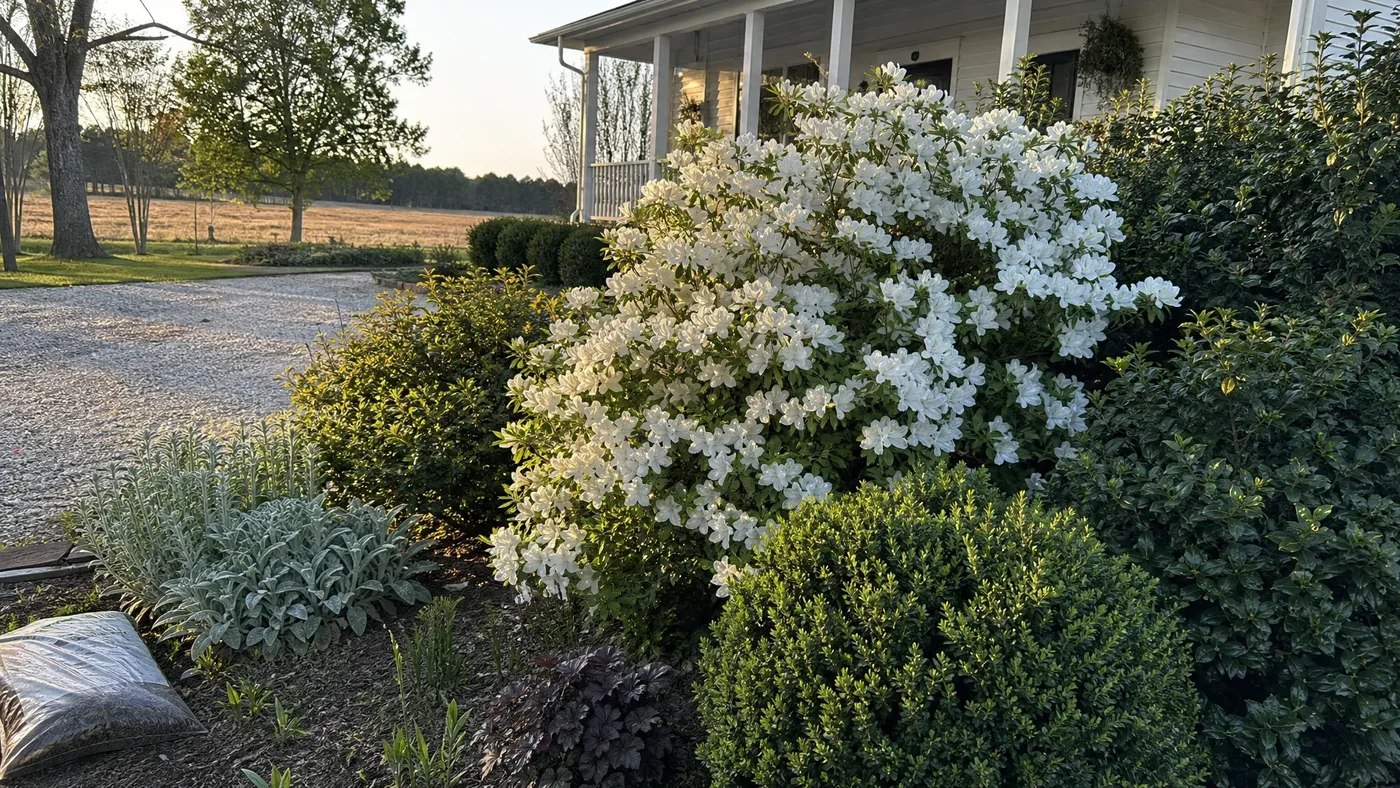
Using Mrs G.G. Gerbing Azalea in a White or Moon Garden
Most people expect a white garden to glow at dusk simply because everything in it is white. Then they stand at the property line as the light drops and see a pale, flat smear, with the best plant lost against a light fence. Why do some white gardens hold the light while others wash out? It comes down to siting and contrast, not to how many white flowers you plant.
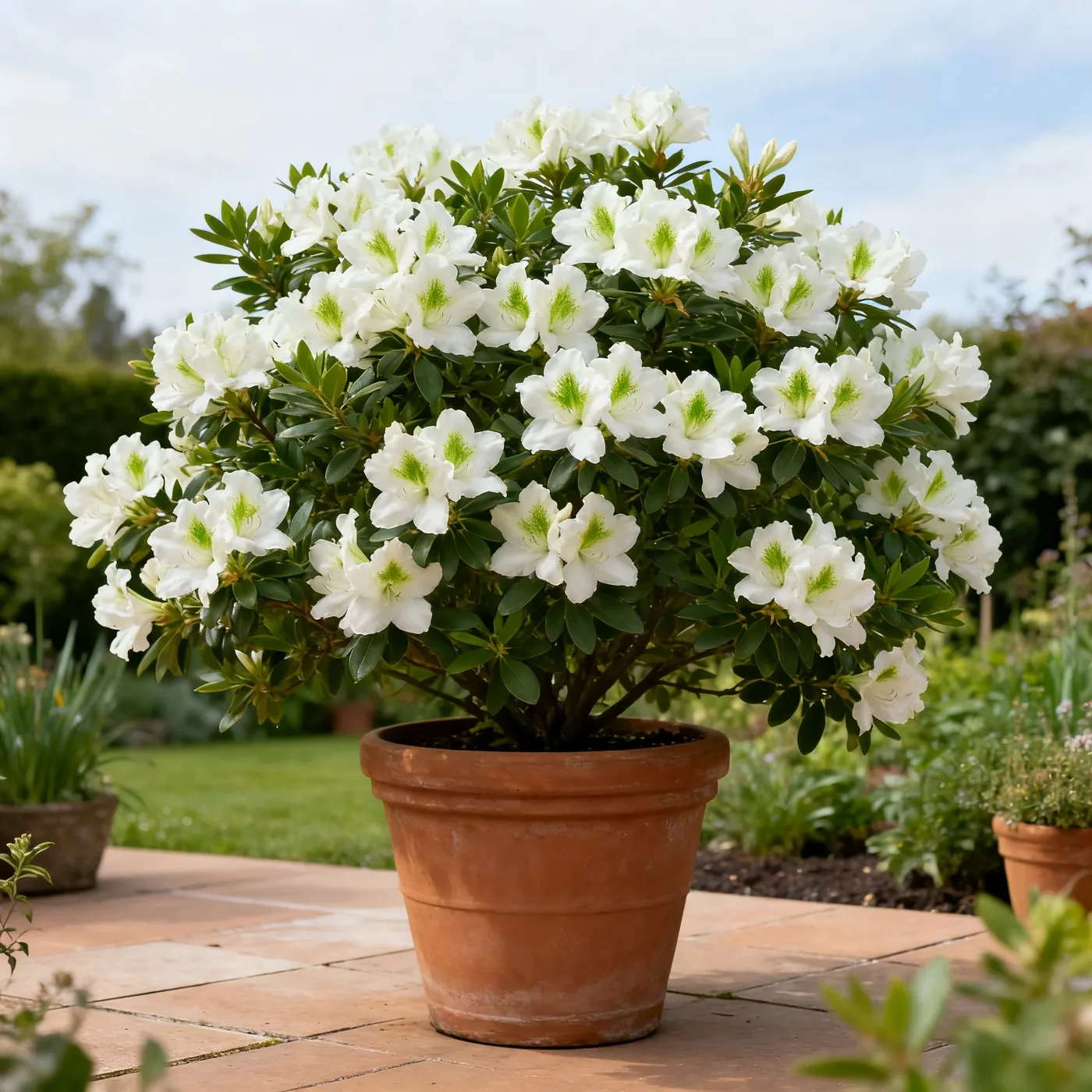
Mrs G.G. Gerbing Azalea is a good test of that. Growers describe its 3-inch blooms as so dense that the shrub "appears as if the whole entire plant is pure white." That much solid white needs a dark frame, or it reads as a blank patch instead of a plant.
This guide covers everything you need to know about using this azalea in a white or moon garden, from reading your garden at dusk to siting, pairing and planting around the single flowers.
Reading the Whole Garden at Dusk
Walk to the place your white garden is seen from most, usually the property line, the driveway or a window, and look at it just after the sun drops. Everything pale glows: the fence, the gravel, the painted trim. The white plants you counted on disappear into them.
The reason is simple. As color drains from the evening, your eye keeps only brightness, and white reads only against something darker. Light on light vanishes. That is why a white garden on a pale ground fails, and why the dark parts of your yard matter more than the white ones.
Do this survey before you buy or move anything:
- Stand at the spot where the garden is seen from most often, at dusk, and note every surface that still looks pale.
- Note which side of the garden holds the last light, usually the side open to the sky.
- Mark the darkest masses you already have, such as hedges, tree trunks and shaded walls. These are your backdrops.
- Mark where people will sit or walk, because those spots decide how close the flowers need to be.
If you can, repeat the survey in spring, when Southern Indica azaleas bloom. Evergreen screens look the same all year, but low sun angles and open sky change with the season, and a spot that holds light in March may not in July.
The shrub belongs where a dark mass sits behind a pocket of lingering light. Most gardens have one such spot. Finding it takes an evening, not a design plan.
Placing Mrs G.G. Gerbing Azalea Where Light Falls Last
A Gerbing on the east side of a house gets pleasant morning sun and still looks flat at dusk, because by evening the whole bed has sunk into shade and the bloom has nothing left to catch. Planting it where the sky stays open is the fix.
The constraint is that azaleas do best with morning sun and protection from afternoon heat, and extension guidance for the Southeast says the same. Partial shade is the target, and filtered sunlight through trees or the north side of a house both work. So you want bright sky at dusk, but not hot western sun at four in the afternoon. Our sun and light guide covers that balance in detail.
If You Have High Tree Canopy
Plant the azalea on the edge of the canopy, at the side facing open sky. The leaves overhead cool the afternoon, and the low evening light slides in sideways and lights the flowers.
If You Have a Wall or Fence
Choose a north or northeast face, and keep the shrub well out from the surface. The Southern Indica group reaches 6–12 feet tall and 6–8 feet wide, and we see people crowd these shrubs against walls in their first year. Our maturity guide shows what that growth looks like.
If the Backdrop Is Pale, Move the Mrs G.G. Gerbing Azalea
One of the most common questions we get is why a Gerbing in full bloom looks dull in the yard but bright in photos taken at noon. Almost always the backdrop is the problem. Work through the symptoms below in order.
| What you see at dusk | Likely cause | Fix |
|---|---|---|
| Bloom fades into the fence or wall | Backdrop is as light as the flowers | Plant a dark hedge behind, or move the shrub in front of one |
| Bloom is bright but leaves look gray behind it | Lace bug stippling on the foliage | Check the leaf undersides and treat |
| Whole shrub sits in gloom, no glow | Too far from open sky | Prune back a neighbor or relocate toward the light |
| Bloom looks like one flat blob | No depth or mid-tone around it | Add darker plants in front and behind |
If the cause is leaf damage, the cure is not a new location. Lace bugs cause bronzed or bleached-out leaves, and on an azalea this white the dull foliage shows. Our common problems guide walks through treatment.
If the cause is the backdrop, try the cheaper fix first. Put something dark behind the shrub before you dig it up. Only move it if no screen can go there.
If you do have to move it, do it with the whole picture in mind. A shrub shifted ten feet along the same pale fence will look just as flat. Choose the new spot by the dark mass behind it, then check that the spot still gets filtered light, not hot afternoon sun.
Pairing Mrs G.G. Gerbing Azalea With Darker Leaves
A row of deep green hollies behind a Gerbing makes the bloom look lit from within, while the same shrub in front of a pale gray shed looks dim. The dark leaves do the work, so choose them as carefully as the azalea.
Choose companions by leaf value, not by bloom. Good partners include hollies, camellias with glossy dark leaves, boxwood, cherry laurel and Southern magnolia. At ground level, dark mondo grass or burgundy foliage plants such as heuchera hold the low edge. Check each one's hardiness against your own zone before you buy.
Use these rules when you are choosing:
- If the companion has glossy leaves, it will pick up a little sky light at dusk and add depth. Matte dark leaves absorb light and give the strongest contrast.
- If you want a second flower color nearby, keep it deep, such as burgundy or dark purple. Pastels pull attention off the white.
- If a neighbor has silver or variegated foliage, put it in front of or beside the bed, not directly behind the azalea, because it lightens the very backdrop you are building.
- If deer are a problem, remember that NC State reports Southern Indica hybrids are frequently damaged by deer, so protect the azalea itself or fence the bed.
Building the Bed Around One Shrub
We tell customers to design the bed as a stage with one performer. In a good white garden, you can point to the Gerbing from the far side of the yard without hunting for it. Everything else in the bed supports that one view.
Layer it from back to front, using the dusk survey from earlier to decide where the dark mass goes:
- Back layer. Plant dark evergreen shrubs or a hedge as the screen. Place it far enough behind the azalea that the two root systems do not compete.
- Anchor. Set the azalea in front of the screen, off center so the eye finds it on a diagonal. Give it its full 6–8 feet of width in the plan, even though it looks small in a pot.
- Middle layer. Add lower dark-leaved shrubs and a few pale perennials that stay below the azalea's flowers, so they do not compete in height.
- Front edge. Finish with a dark groundcover or mulch. A bright edging stone will draw the eye away from the shrub.
Soil is the same for every layer: acid, well drained and rich in organic matter. Azaleas generally prefer a pH between 4.5 and 6.0, and the whole bed should be prepared for that. Poor drainage is the usual way a bed like this fails, so do not dig a basin that holds water. Our landscape ideas guide covers specimen and hedge layouts if you want a different shape.
Texture and Scent at Arm's Length
At the edge of a path, a visitor brushes the bed with a sleeve and leans in to look. That is when texture matters, and when you notice what is missing. The Gerbing gives you a dense mass of bloom and little else at that moment, so the bed has to supply the rest.
Put fine texture beside the azalea, not behind it. Mondo grass, ferns and low sedges soften the base and give the eye a change of pattern next to the dense bloom. Keep the path a full arm's length from the leaf edge. The mature width of 6–8 feet in the Southern Indica group means a shrub planted close to the walk will arch across it within a few years.
For scent, rely on neighbors, not on the azalea. Gardenia, sweet olive and star jasmine are the usual choices where your zone allows them. Pick plants that flower during or after the azalea's spring bloom, and set them near the bench, not the back of the bed.
If you seat people, or pets, near the shrub, know that the ASPCA lists rhododendron as toxic to dogs, cats and horses. Our toxicity guide goes through what the sources say.
Single Petals Up Close in Moonlight
On a clear night near the full moon, walk up to a Gerbing in bloom and stop at the spot you picked for the bench. The flowers hold their color while the leaves go black, and each bloom reads as its own pale disc, three inches across.
That clear edge comes from the single flower form. Each bloom has one layer of petals, so you see the outline of every flower instead of a fuzzy ruffled mass. Packed densely over the whole shrub, the single blooms add up to the solid white growers describe.
Because the color is pure, flaws show. If petals turn brown with a pattern of lines and stay firm instead of falling, that is likely petal blight. Texas A&M describes affected petals as having a veined appearance and remaining firm. A few pale tan petals on a moonlit bed are far more visible than they are in daylight.
If you see them, pick off the affected flowers and clear fallen petals from under the shrub so the bed stays clean for evening viewing. Do it in daylight, when you can see what you are removing.
Keep other light away from the bench. A porch lamp or bright path light will wash out the moon effect and flatten the glow you spent the evening building. If you want a light, aim it at the dark backdrop, not at the flowers.
Making Mrs G.G. Gerbing Azalea the White Garden's Backbone
The plan comes down to three decisions. Look at the garden at dusk to find where the last light lands, put the azalea there with partial shade and room to reach its width, and surround it with dark leaves so the white has something to stand against. Fix the backdrop before you move the shrub, and fix lace bug damage before you blame the site.
Done well, the dense single blooms do what no scattering of smaller white flowers can, and carry the whole garden on one shrub. You end up with a bed that reads from the property line in the dim, and a bloom that seems to hold the last light of an evening.
Mrs G.G. Gerbing Azalea
Nursery-grown Mrs G.G. Gerbing Azalea in sizes from 1 Gallon, shipped to your door.
From $26.99
Shop Now →Gerbing azaleas grow best in the filtered light of our shaded rows, rooted in acidic soil that drains freely, and that is how we raise the ones that end up glowing in an evening garden. We are a small business of growers, and every top-quality shrub we sell is propagated and potted on our own land. If a white bed at dusk is what you are picturing, start with one of ours.