Mrs G.G. Gerbing Azalea Caterpillars: Identification and Treatment
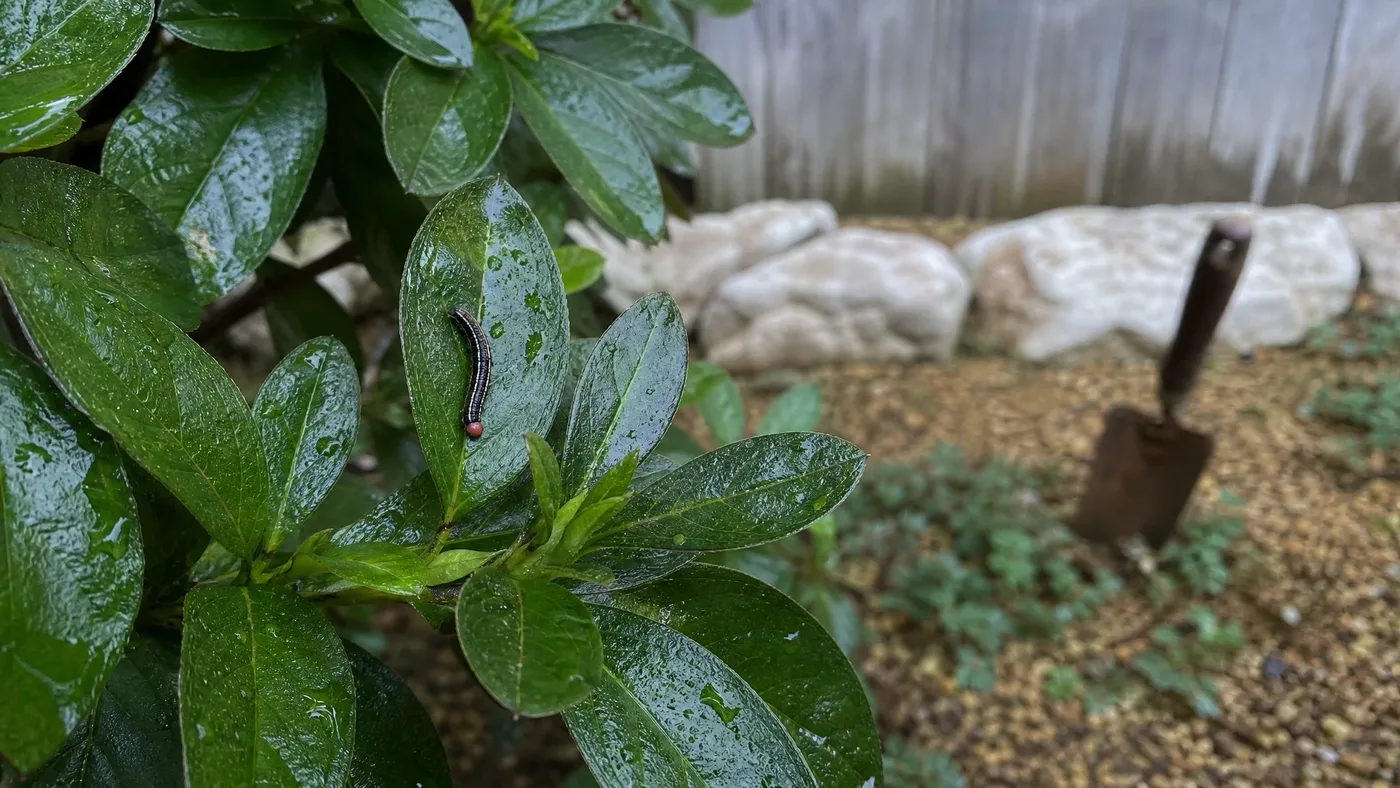
Most people meet the azalea caterpillar at the end of its story. By the time a branch of Mrs G.G. Gerbing Azalea looks stripped, a pale moth has already laid her eggs in a mass on the plant, the young have hatched and fed side by side, and the big, hungry stage has nearly finished. The chewed leaf edge you find in late summer is the last chapter. The first chapters happened weeks earlier.
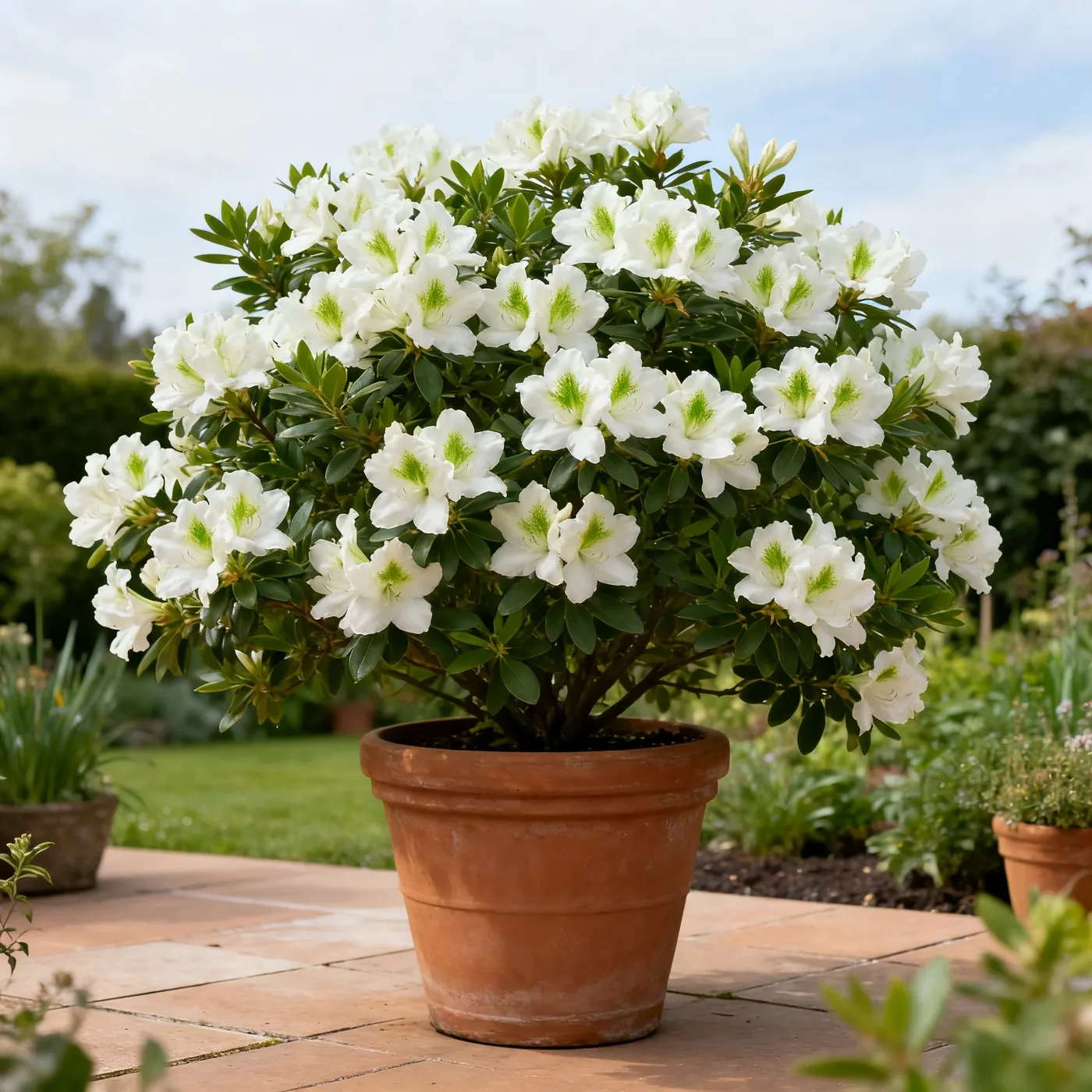
Gerbing is a Southern Indica type with large, broad leaves, and the caterpillars seem to prefer indica azaleas. That makes this cultivar a more likely host than the small-leaved compact types. Getting the diagnosis wrong means either a needless spray or a stripped shrub.
We'll walk you through four yards, a narrow side bed, a windy corner, a pot on a deck and a woodland edge, then show you how to read the chewed leaves and when to scout.
Narrow Side Bed Beside the Neighbor's Fence
In a tight, shaded bed the first sign is rarely a hole. Look for one patch of leaves on a single branch that has gone see-through, eaten down to the veins, with a clump of small caterpillars on it. Newly hatched caterpillars feed together and skeletonize leaves, so early damage is a cluster, not a scatter. Young ones carry red and yellow stripes. Mature ones are about 2 inches long, black with yellow or white markings and red heads.
This bed is the easiest case because you can reach every branch. The fence blocks wind, so a moth can settle and lay her eggs in peace, and the broad Gerbing leaves give a feeding group plenty of cover on the undersides. Shade suits the plant here (see our guide to sun and light needs), but it also means you will not notice a problem unless you look under the leaves.
Hand-Picking Step by Step
Hand-picking works when the colony is still on one or two branches. Work through these steps:
- Check the undersides of the leaves every week from July on, starting with the branches nearest the fence.
- When you find a stripped patch, follow it to the cluster. The caterpillars will be within a few leaves of the damage.
- Snip off the whole leaf or twig tip that holds the group. This is faster than prying them off one by one.
- Drop the cuttings into a bucket of soapy water and leave it for a day.
- Look again in three days, because a missed cluster can finish a branch quickly.
Customers usually ask us whether the hairy look means they need gloves. The caterpillar appears hairy but is harmless to humans and can be picked off by hand, according to the University of Florida extension, though gloves do no harm if you prefer them.
The Life Around the Bed
Leave a few things alone while you work. A caterpillar that carries tiny white cocoons on its back has already been claimed by a parasitic wasp, and that one will not survive to pupate. Spiders on the fence and flies hovering at the leaf edges are doing the same work. Take the clean, unparasitized clusters and leave the studded ones where they are.
A Mrs G.G. Gerbing Azalea on a Windy Corner Lot
An exposed corner changes who finds the plant. Moths fly freely across open ground, and the shrub stands out on all sides. It also stands taller, since Southern Indica hybrids can reach 6 to 12 feet.
We cannot give you a number for how wind changes egg-laying, but the pattern we describe to customers is that exposed shrubs get fewer sheltered, crowded clusters and more scattered feeding spread across the crown.
Birds are the other half of the story. On a windy corner the large Gerbing leaves flip and flutter, and caterpillars sitting on them are easy for birds to spot from the fence line or a nearby tree. That predation is real but uneven.
A bird will clear the low, visible branches and miss the dense interior, so a plant can look fine from the street while the middle of the shrub is being stripped.
Tell Wind Damage From Feeding
Wind tears large leaves, and the result can pass for chewing. Torn leaf edges are ragged and brown at the break, and the damage lies along one side of the shrub, the side facing the prevailing wind. Caterpillar feeding sits in patches on any side, with clean-cut edges or bare veins, and with dark droppings on the leaves below. If you find a caterpillar on the leaf, that settles it.
What to Do Here
Do a slow walk-around of the shrub with a hand parted into the foliage, not a glance from the sidewalk. Pick off what you can reach. If the interior has a large young group you cannot clear by hand, spinosad products do a good job of controlling small caterpillars, and the key word is small.
Read the label, spray the undersides while the caterpillars are still striped and young, and skip the spray once they are big, because a mature caterpillar is nearly done anyway.
Pot on a Hot Deck Under Eaves
A potted Gerbing on a deck is an island. Fewer moths find it, but when one does, the eggs have the plant to themselves. There are no wasps in the neighboring bed, no ground predators and often no birds under the eaves. Damage on a container plant tends to be all or nothing: a clean shrub for weeks, then a stripped branch within days. Scout it more often than you would a plant in the ground.
Heat complicates the reading. Pots run hotter than soil, and a stressed azalea leaf can look pale and papery before any insect touches it. Lace bugs add to the confusion, since they cause bronzed or bleached-out leaves. Bleaching or stippling means a sucking insect or heat. Missing leaf tissue means a chewer. Do not treat a chewer with a lace bug remedy, or the reverse.
Treat the Plant, Then the Pot
With no predators to help, hand-picking is your main tool, so check the undersides every two or three days through August and September. If young caterpillars are present in numbers, spinosad is the option the sources support, and a pot lets you move the plant off the deck before you spray, so nothing drips onto the furniture. Wait for the foliage to dry before bringing it back.
Then look at the pot's conditions. A shrub that is also dry and baked has less to give a caterpillar attack. Move it to a spot with morning sun and afternoon shade, and keep the root ball evenly moist, as laid out in our watering guide. A cooler, steadier plant tolerates a lost branch far better than a stressed one.
Mrs G.G. Gerbing Azalea Beside a Woodland Edge
At a wooded border the caterpillars do not need to find your plant, because they are already living next door. Native shrubs and trees along the edge carry their own insects, and some of them cross onto a large-leaved Gerbing. You will see feeding here most years. What changes is the cast around it: wasps, flies, spiders and birds are all abundant, and they hold most outbreaks in check before you notice.
In our rows, the plants that sit beside wild growth are the ones where we most often find a caterpillar covered in cocoons. That is a sign of a working system, and it is the main reason spraying is a poor first move here. A broad spray on the whole shrub can reach the wasps and flies as well as the caterpillars, and it spares nothing that was about to do the job for free.
When Tolerance Is the Right Answer
Let the edge handle it when the damage is on a few branches, you can find parasitized caterpillars among the live ones, and it is already late in the season. Feeding runs July through October, and caterpillars do 80 to 90% of their feeding in the last two or three days before pupation, so a branch can look ruined suddenly even when the colony is almost finished.
Step in only if a young group is large and still growing, or if the plant is newly planted and has little reserve. Hand-pick first. Hold off on cutting out stripped branches until the next spring, and prune after bloom as described in our pruning guide.
Rule Out the Deer
Woodland edges bring another chewer. NC State notes that Southern Indica hybrids are frequently damaged by deer, and deer leave torn, ragged shoot tips, often well above the ground, with no droppings of the caterpillar kind. Caterpillar damage leaves leaf edges and bare veins. If whole shoot ends are missing, look for hoofprints, not larvae.
Reading Chewed Leaves by Their Edges
Put the four yards together and one habit carries across all of them: read the edge before you reach for any treatment. Large leaves keep a record. A caterpillar leaves a different edge from a lace bug, a leafminer or a gust of wind, and the pattern on a single Gerbing leaf will usually tell you which one you have.
| What you see | Likely cause | First move |
|---|---|---|
| Leaves eaten to the veins in a patch, small striped caterpillars beneath | Newly hatched azalea caterpillars | Snip the cluster, or use spinosad if it is large |
| Whole leaves gone from a branch, black caterpillars with red heads | Mature azalea caterpillars | Hand-pick, then leave the rest to finish |
| Pale or bronze stippling, dark specks on the undersides | Lace bugs | Check the undersides, treat for lace bugs |
| Winding tunnels or blotches inside the leaf | Leafminers | See our leafminer guide |
| Ragged tears on one windward side, brown at the break | Wind or deer | Look for hoofprints, add a windbreak |
When to Scout in the Deep South
Infestations run from July through October, with one or two generations a year. The University of Florida extension puts most of the damage in the Southeast in August and September, continuing through October in Florida. Start your weekly checks in early July and keep them going until the first cool nights. A second wave in fall looks like the first, only on a shrub that is already tired.
Lace bug eggs sit on the undersides of the leaves through winter, as Kentucky extension entomologists describe, so a leaf with stippling in spring is a different problem from a leaf with a bite out of it in August. For the other usual suspects on this cultivar, see our guide to common problems and our page on leafminers.
What Each Yard Taught Us About Mrs G.G. Gerbing Azalea
The narrow bed taught us to look under the leaves early and pick by hand while the colony is small. The windy corner taught us to tell torn leaves from chewed ones. The deck pot showed that an isolated plant needs closer watching and a gentler hand, and the woodland edge showed that a shrub with plenty of natural enemies around it usually needs patience more than a sprayer.
In every case, spinosad is for small caterpillars, and mature ones are best left alone. If you remember one picture from late summer, make it a single caterpillar left on a leaf, its back studded with small white wasp cocoons. It is proof that the yard is quietly doing its own pest control.
Mrs G.G. Gerbing Azalea
Nursery-grown Mrs G.G. Gerbing Azalea in sizes from 1 Gallon, shipped to your door.
From $26.99
Shop Now →Caterpillar season is easy on a Mrs G.G. Gerbing that has spent its life in our acid, well-drained soil under part shade, which is how every one is raised on our farms. Growing top-quality shrubs is all we do, and each plant we sell was tended by us, never bought in. Should your yard be missing a healthy azalea, let one of ours be where you begin.